

Gallbladder Stones & Cancer
Gallbladder cancer is not uncommon in north and east India- especially along the Gangetic belt, more commonly in women. It is a serious condition that arises in the gallbladder, a small organ stuck to the undersurface of the liver. It is an organ that has an additional store of bile ( a digestive juice ) , over and above the bile that directly flows from the liver to the intestine through the bile duct. The exact cause of gallbladder cancer is not fully understood, but certain risk factors may increase your likelihood of developing the disease.
Risk Factors
Age
Gender
Gallstones
Obesity
Chronic Inflammation
Symptoms
Gallbladder cancer often doesn’t cause symptoms in its early stages. When symptoms do appear, they may include:
Abdominal pain
Jaundice
Nausea or vomiting
Gallstones
Bloating / indigestion
Diagnosis
If gallbladder cancer is suspected, your doctor may perform several tests, including:
Imaging tests
Blood tests
Biopsy
Diagnosis after surgery for Gallstones
Laparoscopic Cholecystectomy
A large number of patients are found to have gallbladder cancer when the biopsy report is collected by the patients after they have had surgery to remove the gallbladder for gallstone disease – after a Laparoscopic or Robotic Cholecystectomy. If you any of these words – ‘ cancer ’ or ‘carcinoma’ or ‘malignancy’ or even ‘dysplasia’ – please rush to your surgeon or to a surgeon who has expertise in treating gallbladder cancers within 24 hours of receiving the report, if not earlier. Very likely you will need a radical surgery without any delay. In this situation DELAY ACTUALLY KILLS !
Treatment Options
Treatment depends on the stage of cancer and your overall health. Common approaches include:
Radical Surgery
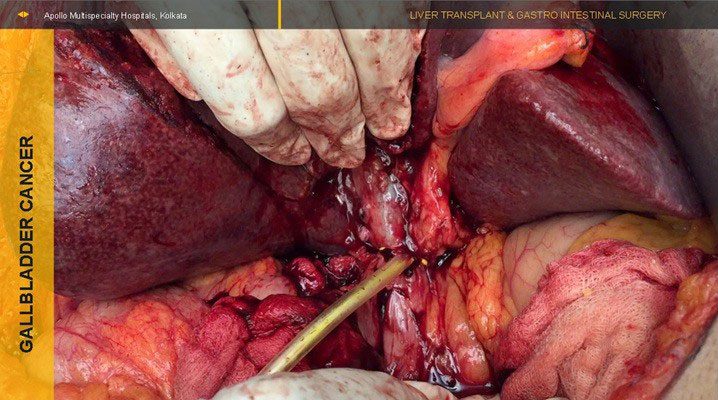
The ideal first treatment for gallbladder cancer that has not spread , usually would be a radical cancer surgery – to remove the gallbladder ( cholecystectomy ) and the tumour alongwith a part of the liver and the lymph nodes surrounding that area. This operation is called a RADICAL CHOLECYSTECTOMY and is often performed by Laparoscopic or by Robotic Surgery.
Locally advanced cancers may invade into the nearby arteries ( Right hepatic artery ) or veins ( Portal vein ) or neighbouring organs ( liver, colon etc ). Earlier such tumours were regarded as inoperable and all hope of cure would be given up. Nowadays, especially with expertise gained in liver transplant, such cancers can be taken out by super radical operations which may include :
- Liver resection
- Arterial or portal venous resection and reconstruction by vascular / microvascular surgery
- Removal of a part of the colon: segmental colectomy
Please note that liver transplant has no role in treating gallbladder cancers. But the vascular surgery and liver resection skills and techniques used in transplant are needed to perform such radical cancer operations. These radical operations – if they can remove the entire cancer – are the standard of care at centres of excellence the world over nowadays, and are also regularly performed by our surgeons who have expertise in liver transplant and gastrointestinal oncosurgery. DO NOT ASSUME YOUR CANCER IS INOPERABLE : in many cases, the decision for surgery is not as straightforward as it may seem !
Chemotherapy
This may be recommended after surgery to kill any remaining cancer cells so that the cancer does not come back ( recur ). Palliative chemotherapy may be considered when the cancer has spread ( Stage III or Stage IV cancer ) – the results unfortunately are not very good.
Radiation Therapy
Sometimes used in combination with other treatments.
Living with Gallbladder Cancer
Follow-Up Care
Conclusion
Gallbladder cancer is a challenging diagnosis, but understanding the condition can help you make informed decisions about your care. Don’t hesitate to reach out to us with any questions you may have. You are not alone in this journey.
Summary Points
- Gallbladder cancer can be cured if detected early
- Do not forget to look at your gallbladder biopsy report after your surgery for gallstones (after your Laparoscopic or Robotic Cholecystectomy)
- Do not rush to have a biopsy of your gallbladder tumour – it may cause more harm than benefit!
- The decision whether your gallbladder cancer can be removed by surgery ( operable or not ) is a very complicated decision that can only be taken by a specialist surgeon who is well trained and has expertise in performing the most radical operations for this kind of cancer. Too many gallbladder cancers are presumed to be inoperable and sent for palliative chemotherapy only, with dismal results – many are actually operable and therefore curable.
- Almost all patients will need chemotherapy after surgery to reduce the chances of the cancer coming back.